Your Gabapentin Didn't Stop Working Because Your Body Got Used To It. It's Something Your Neurologist Wasn't Trained To Treat.
Burning That Comes Back Every Night. Words You Can't Find. Relief That Wore Off. This Isn't Tolerance — It's The Damage Continuing While The Medication Works Somewhere Else.

You take it at the same time every night because they told you consistency matters. The fan's still pointed at the bed. The ice pack's still on the nightstand. And you still wake at two — and nobody, not your GP, not the podiatrist, not the neurologist who wrote the prescription, has ever told you why it stopped working.
Because it did work. For a while it genuinely worked. Then the benefit wore off, and the answer was a higher dose, and that worked for a while too. Nothing held.
You're tired in a way sleep doesn't fix. You get dizzy standing up and you've held onto the counter more times than you'd admit. Your ankles swell — on a medication you take for your feet.
Here's what nobody told you: your body didn't get used to it. You're not failing the treatment. The medication is doing exactly what it was designed to do — working between the nerve and your brain. It does that whether the damage underneath gets better or worse.
And your feet still burn.
Not as much. You'd say thirty percent better on a good day. But you're at a dose you never imagined being on, you're paying for it with your own head, and the last conversation with your neurologist was about going higher again.
Here's what nobody explained: you are not building tolerance to a treatment.
Gabapentin doesn't treat nerve damage. It was never designed to. It works between the nerve and your brain, reducing the nerve's ability to transmit the pain message. It turns down the volume on the alarm.
The alarm is not the problem. The damage inside the nerve is the problem — and the medication doesn't reach it, doesn't claim to reach it, and was never pointed at it.
That's why the dose keeps climbing. Turning up the volume control on something aimed at the wrong location produces exactly the curve you've lived through.

Does This Sound Like You?
- It worked at first and then it didn't — you assumed your body adjusted. Tolerance is real, but so is a medication that was never addressing the damage underneath.
- Every time you said it stopped helping, the answer was more — never a different approach, never a second question.
- You've been offered a different drug in the same class — pregabalin instead of gabapentin, or an antidepressant used for nerve pain. Different molecule, same target: the signal, not the nerve.
- You're tired in a way that sleep doesn't fix — you blamed age, or the diabetes, or not sleeping properly because of the burning. It started somewhere after the dose went up.
- You've gained weight you can't account for — on a medication you take for your feet.
- You're unsteady on your feet in a way you weren't before — reaching for a counter, a handrail, the back of a chair. On a medication you take for your feet.
- The relief you get now is partial and it always has been — better than nothing, never enough, and it stops at the same place no matter what they write.
Here's the key: not one of those means the medication is failing. Gabapentin is doing precisely what it was designed to do. It is first-line therapy for painful diabetic neuropathy and it works — on the signal.
The nerve sending that signal is exactly as damaged as it was the day you started.
If you checked two or more of those, you're not failing the treatment. You're at the top of a ladder that was never leaning against your damage. And no dose at the top of that ladder is going to reach it, because the ladder is in the wrong place.
That changes everything about what to do next.
Why Every Doctor You've Seen Missed It — And Why Nothing You've Tried Has Worked
Diabetic peripheral neuropathy affects roughly half of people with diabetes over the course of the disease [1]. Most will have seen three or four clinicians about it. Almost none will have had this conversation. Here's why:
- Your primary care doctor checked your circulation. — Pulses, ankles, capillary refill. Reasonable — burning feet in a diabetic can be vascular, and it's important to rule out. Yours came back fine, which is exactly what happens when the problem is the nerve and not the artery. Compression socks and more walking is what follows a normal vascular exam.
- Your podiatrist was looking for wounds. — Ulcers, infection, pressure points, skin integrity. That work genuinely prevents amputations and it matters enormously. But the exam is designed to find damage on the outside of your foot. "Everything looks healthy" is a true statement about your skin and tells you nothing about your nerve.
- Your endocrinologist showed you the chart. — A1C down, weight down, kidneys stable, you're doing everything right — and they're correct. Glycaemic control is their assignment and you're succeeding at it. But bringing your blood sugar down stops new damage. It doesn't repair what's already there, and the Cochrane review of glucose-control trials found the effect on neuropathy in type 2 diabetes was small and didn't reach significance [2].
- Your neurologist prescribed exactly what the guidelines say to prescribe. — Gabapentin, pregabalin and duloxetine are first-line for painful diabetic neuropathy. Titrating upward when a dose stops working is standard, correct practice. The prescription was right. The scope was the problem. Symptomatic pain management is what that appointment is for. Nobody in that room was assigned the tissue.
And there's one more thing almost nobody checks. Metformin depletes vitamin B12 — a randomised placebo-controlled trial in the BMJ found a substantial, progressive drop over four years of use [3]. B12 maintains the protective coating around every nerve fibre. The ADA recommends periodic testing for metformin-treated patients. In practice, most people are never tested.
Here's what all of it has in common: every piece of care you've received targets your circulation, your skin, your blood sugar, or your pain signal.
Not one of them was ever aimed at the nerve tissue itself.
I'm a hairdresser, so everybody blamed the standing. On the gabapentin I was holding the back of the chair between clients because the room kept tilting, and my ankles were swelling on a tablet I take for my feet. My daughter found this and I only started it to stop her going on about it. Eleven months now.
— Marianne D., Verified Customer
Why It Wore Off: The Medication Was Never Aimed At The Damage
Here's the geometry that explains four years of your life.
A nerve is a wire. The damage is in the wire. The pain message travels from the wire to your brain.
Gabapentin works on the transmission — it reduces the nerve's ability to send that message. It is genuinely effective at that, which is why it's first-line and why it helped at all.
But consider what that means. The wire stays damaged. It keeps generating the signal. All you've changed is how much of it arrives.
So when the relief starts thinning — and it does, because the damage is still there and often still progressing — there's only one lever available. Turn the volume down further.
That's not your body getting used to the drug. It's the predictable result of managing an output while the input runs untouched.
And here is the part that should have been said out loud at the first appointment. In the Cochrane review of gabapentin for chronic neuropathic pain, only three or four people in ten got meaningful pain relief — and side effects were more common on gabapentin than on placebo [9]. More than half the people taking it are getting the tiredness and the dizziness without the relief.
And each turn of that dial costs you something upstream. Gabapentin's side effect profile is dose-dependent: sedation, cognitive slowing, word-finding difficulty, weight gain. The higher you go, the more of your day you trade for the same incomplete relief.
This is why the ladder feels endless:
- The medication reduces the signal — it doesn't change the tissue producing it
- The damage continues doing what damage does, independent of your dose
- Breakthrough burning has one available answer: more
- Every increase costs more cognitive function for the same partial result
- And at the top of the ladder, the sentence waiting for you is some people just have to learn to manage it
You were never failing the treatment. The treatment was pointed at the alarm.

Four Things Go Wrong Inside The Nerve. Almost Nothing Addresses All Four.
If the damage is inside the nerve, the obvious question is what a damaged nerve actually needs.
There isn't one thing going wrong in there. There are four, simultaneously, all from the same cause.
One — sugar backs up inside the fibre. Glucose floods the nerve faster than it can be cleared. The pathway that normally moves it out is thiamine-dependent, and when it's overwhelmed the glucose diverts into damaging routes instead.
Two — that sugar converts to sorbitol. An enzyme called aldose reductase turns the excess into a compound that pulls water into nerve tissue. The nerve swells. That internal pressure is a large part of what tingling actually is.
Three — oxidative stress builds inside the fibre. The process generates free radicals and the nerve's own antioxidant defences get overwhelmed. This is the part most closely associated with burning.
Four — the protective coating thins. Every fibre is wrapped in a sheath that keeps the signal clean. When it degrades, signals arrive wrong — which is why numbness in one patch and burning in another happen at the same time.
And almost everything sold for neuropathy addresses only one of them.
A B12 supplement works on the fourth. Alpha lipoic acid alone works on the third. A benfotiamine product works on the first. Each is doing something genuine — for a quarter of the problem. Which is why people try something for a month, feel nothing, and conclude nothing works.
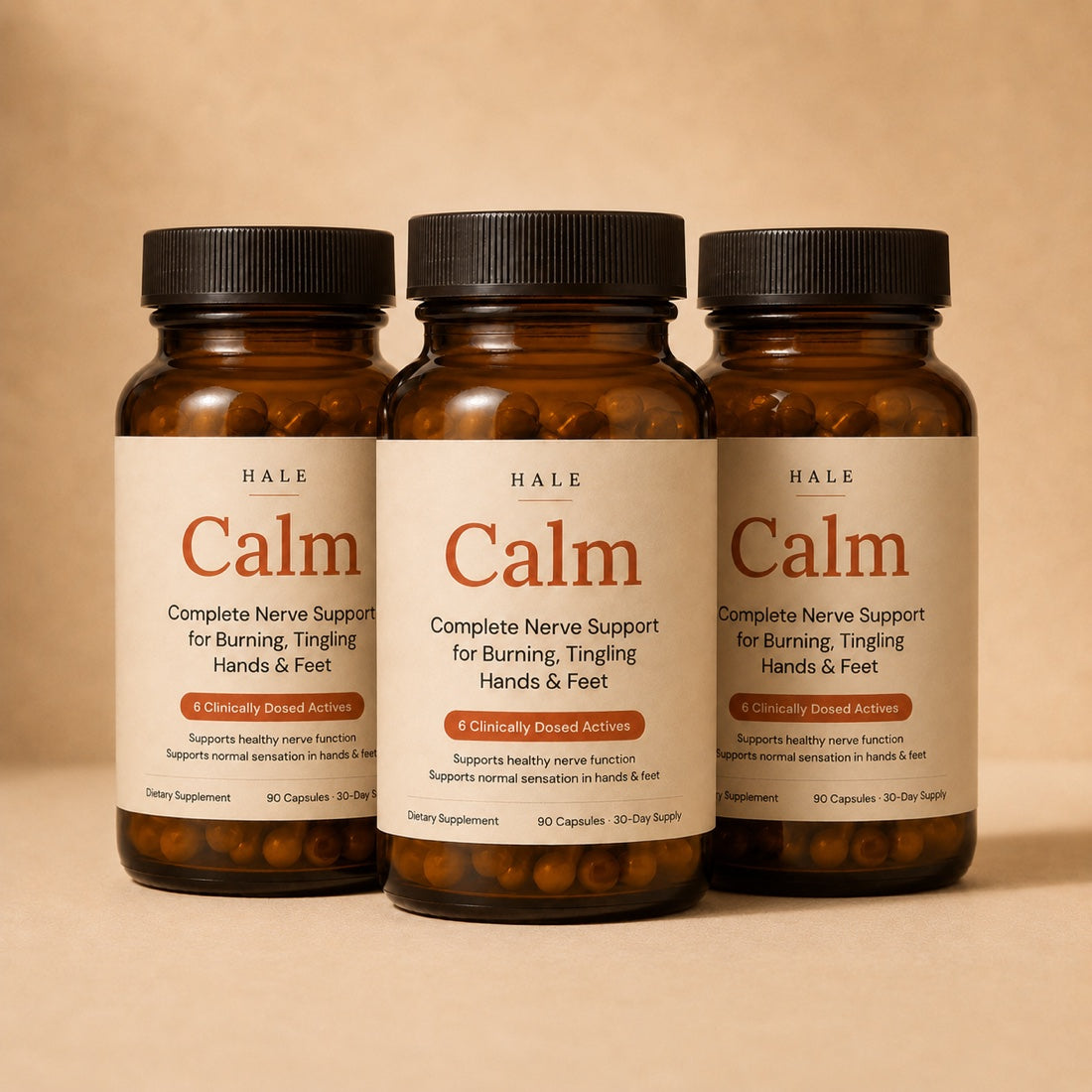
Hale Calm was built backwards from all four:
- Benfotiamine, 600mg — the fat-soluble form of B1. Regular thiamine is water soluble and largely flushes before reaching nerve tissue. Supports the pathway that clears backed-up glucose inside the nerve [4]
- Alpha lipoic acid, 600mg — works in both water and fat, which is why it reaches inside the fibre where most antioxidants can't follow. One of the most studied compounds in diabetic neuropathy specifically [5]
- Amla extract, 500mg — a natural aldose reductase inhibitor. Supports the body's normal handling of the glucose-to-sorbitol conversion behind the swelling [6]
- Methylcobalamin, 1,500mcg — the active form of B12. No conversion required, which matters because not everyone converts the cheap form well [7]
- Magnesium bisglycinate — benfotiamine can't do its job without it. Included as a cofactor, in the glycinate form for absorption
- Vitamin D3, 2,000 IU — low vitamin D is common in type 2 diabetes and has been associated with more severe neuropathy symptoms [8]
Six actives. Four routes. Every one at the dose it was studied at.
There is no vitamin B6 in it, deliberately — high-dose B6 taken chronically can itself cause peripheral nerve damage, and it appears in a surprising number of neuropathy formulas anyway.
Hale Calm is not a replacement for your prescription. It doesn't work on the signal and it isn't trying to. It's aimed at the tissue underneath, alongside whatever your doctor has you on. Do not change a prescription without speaking to your prescriber.
Published Research On Key Ingredients
Significant Symptom Relief
Benfotiamine at 600mg produced significant improvement in neuropathy symptom score in a randomised placebo-controlled trial. 300mg once daily did not [4]
Pain, Burning, Numbness Relief
All three improved significantly versus placebo on the primary outcome of the SYDNEY 2 trial of alpha lipoic acid at 600mg [5]
Swelling Stopped At The Source
Amla extract inhibited aldose reductase — the enzyme that converts glucose into the compound that pulls water into nerve tissue [6]
Numbness Addressed At The Nerve
Methylcobalamin — the active B12 form — supports maintenance of the sheath that carries the signal, the layer that thins when patches go numb [7]
*Results are from published studies of individual ingredients, including laboratory models. Doses and forms may differ from those in Hale Calm. Individual results vary. Not intended to diagnose, treat, cure, or prevent any disease.
The 90-Day Protocol For Established Nerve Damage
This isn't a painkiller and it will not behave like one. You already know what a painkiller feels like — it works within hours and wears off. This is the opposite arrangement. Nerve tissue damaged over years responds over months.
Hale Calm is built as a structured 90-day routine — three capsules daily, taken alongside your prescription.

The Saturation Phase
Benfotiamine and alpha lipoic acid begin building in tissue. Most people describe very little here, and that's what should happen. A few notice the nights are marginally shorter.

The Clearance Phase
Where most people first notice something, almost always at night. Falling asleep without the fan. Waking at four instead of two. Amla and magnesium are supporting the sorbitol and cofactor side by now.

The Coating Phase
Methylcobalamin has had time to support the sheath around the fibre. Customers commonly describe the change reaching their daytime — standing longer, holding a cup without setting it down, getting through a shift.

The Quiet Phase
After a full 90 days most people describe the picture as different rather than fixed. Fewer bad nights. And for a number of them, the first appointment in years where the conversation wasn't about going higher.
Backed by a 90-day money-back guarantee. Take all 90 days. If nothing changes, full refund — and you don't need to send anything back.
From "Learn To Manage It" to "I Forgot About My Feet"

★★★★★
Four years, five doctors, and up to 1,800 milligrams before somebody told me to learn to manage it. I sat in the car park for twenty minutes after that appointment before I could drive. Six weeks on this and I stopped watching the clock at four o'clock.
Janet W., 57

★★★★★
Burning at night, pins and needles in both hands, numb patches on my left foot I'd stopped mentioning. Creams did nothing. The soaks did nothing. This was the first thing aimed at why it was happening instead of how it felt. Nine weeks in and the fan is in the closet.
Deborah K., 61

★★★★★
It was never the pain exactly. It was the planning. I knew by four in the afternoon what the rest of my day was going to look like, and I'd already decided what I wasn't doing. Three months in, I stood through my grandson's entire christening and I didn't think about my feet once.
Ray T., 64
Questions People On Gabapentin Ask
"Can I take this with my prescription?"
Many customers do, and you should keep taking your prescription exactly as directed. Gabapentin works on the pain signal between the nerve and your brain. Hale Calm is aimed at the nerve tissue itself. They're pointed at different places, which is the entire reason both can be relevant. Always check with your doctor before adding anything to a medication regimen, and never stop or reduce a prescription on your own.
"Will this let me lower my dose?"
That is not a decision for us and it is not a decision for you alone — it's a conversation with your prescriber. What customers commonly describe is having a different conversation at their next appointment than the one they'd been having. What comes of that is between you and your doctor.
"If it doesn't work on the signal, will I feel anything?"
Not in the first few days, and that's the honest answer. A medication that works on transmission acts within hours. Something aimed at tissue works over weeks. Most people describe the first change somewhere in weeks four to six, usually at night before anything else. The 90-day guarantee exists because that's genuinely how long it takes.
"Why six ingredients? Is this a proprietary blend?"
The opposite — every amount is printed on the label. Six is what it takes to cover four separate damage routes plus the cofactor benfotiamine needs to work. Most neuropathy products contain one active at a real dose, or several at token amounts.
"It's expensive."
$1.09 a day on the three-month protocol. Against four years of copays, creams, socks and a foot massager you used four times. 90-day money-back guarantee, and you can finish the bottles first.
So, Where Can You Get Yours?
Because clinical doses mean fewer bottles per production run and every batch is third-party tested, Hale Calm is produced in limited quantities. Restocking can take months.
The good news: as of this week, Hale has restocked the site with a special reader-only offer — but with demand climbing, there's no telling how long it lasts.
BUY 2, GET 1 FREE
- 3 bottles, free US shipping — a full 90-day protocol
- 90-day empty-bottle money-back guarantee
- 2 pairs of Hale compression socks + the 90-Day Nerve Recovery Plan, free
- Lock in this lot's price before restock pricing kicks in
How Much Longer Will You Let The Number Keep Going Up?
- You deserve to finish a sentence in front of your own family
- You deserve a night that doesn't start with an ice pack
- You deserve an appointment that isn't about a higher dose
Do you really want another three months of this — when the routine costs $1.09 a day?
The Finish-It Guarantee
Take all 90 days. Finish the bottles. If it isn't for you, tell us and we'll refund the order in full. No questions, and nothing to send back.
We'd rather you completed the protocol than half-tried it and wondered.
You won't find it in drugstores — the only way to get it is directly from this site, while this lot lasts.
Limited inventory · Sell-out risk:High
References
- Tesfaye S, Boulton AJM, Dyck PJ, et al. Diabetic neuropathies: update on definitions, diagnostic criteria, estimation of severity, and treatments. Diabetes Care. 2010;33(10):2285–2293.
- Callaghan BC, Little AA, Feldman EL, Hughes RAC. Enhanced glucose control for preventing and treating diabetic peripheral neuropathy. Cochrane Database of Systematic Reviews. 2012;(6):CD007543.
- de Jager J, Kooy A, Lehert P, et al. Long term treatment with metformin in patients with type 2 diabetes and risk of vitamin B-12 deficiency: randomised placebo controlled trial. BMJ. 2010;340:c2181.
- Stracke H, Gaus W, Achenbach U, Federlin K, Bretzel RG. Benfotiamine in diabetic polyneuropathy (BENDIP): results of a randomised, double blind, placebo-controlled clinical study. Experimental and Clinical Endocrinology & Diabetes. 2008;116(10):600–605.
- Ziegler D, Ametov A, Barinov A, et al. Oral treatment with alpha-lipoic acid improves symptomatic diabetic polyneuropathy: the SYDNEY 2 trial. Diabetes Care. 2006;29(11):2365–2370.
- Suryanarayana P, Saraswat M, Petrash JM, Reddy GB. Emblica officinalis and its enriched tannoids delay streptozotocin-induced diabetic cataract in rats. Molecular Vision. 2007;13:1291–1297.
- Sun Y, Lai MS, Lu CJ. Effectiveness of vitamin B12 on diabetic neuropathy: systematic review of clinical controlled trials. Acta Neurologica Taiwanica. 2005;14(2):48–54.
- Shehab D, Al-Jarallah K, Mojiminiyi OA, Al Mohamedy H, Abdella NA. Does vitamin D deficiency play a role in peripheral neuropathy in type 2 diabetes? Diabetic Medicine. 2012;29(1):43–49.
- Wiffen PJ, Derry S, Bell RF, et al. Gabapentin for chronic neuropathic pain in adults. Cochrane Database of Systematic Reviews. 2017;(6):CD007938.
THIS IS AN ADVERTORIAL AND NOT A NEWS ARTICLE, BLOG, OR CONSUMER PROTECTION UPDATE. © 2026 Hale / Cornerstone Studio. All rights reserved.
This is an advertisement. The information provided does not constitute medical advice and is not a substitute for the advice of your doctor. Hale Calm is a dietary supplement intended to sit alongside, not replace, any prescribed care; it is not a treatment for diabetic neuropathy or any other medical condition, and no claim is made that it repairs, reverses, or halts nerve damage. Do not start, stop, reduce, or change any prescription without speaking to your prescriber. Nothing on this page is a recommendation to alter gabapentin, pregabalin, or any other prescribed therapy.
Persistent or worsening symptoms deserve evaluation. New numbness, loss of sensation, non-healing wounds, changes in foot colour or temperature, or any break in the skin of the foot require prompt medical attention. If you have diabetes, ask your doctor about an annual comprehensive foot examination — that assessment is how nerve function is actually evaluated, and nothing here is a substitute for it.
Testimonials reflect the experience of individual customers and are not typical results. Ratings and review counts reflect Hale's own records at the time of publication. Individual experiences vary.
Promotional offers, pricing, and stock availability are subject to change and may end at any time.
These statements have not been evaluated by the Food and Drug Administration. This product is not intended to diagnose, treat, cure, or prevent any disease.
This site is not part of, or endorsed by, Facebook or Meta Inc.